
NCOR Network Project
Bridging osteopathy’s research-practice gap

Bridging osteopathy’s research-practice gap

Historically, the osteopathic profession has been challenged by the gap between research and how it translates within everyday clinical practice. This project has established the UK’s first osteopathic Practice-Based Research Network (PBRN) – a significant advance in research capacity for the profession.
The NCOR Research Network will transform the way clinicians and academics can collaborate, while creating opportunities for evidence-informed care development. By fostering rigorous investigations within everyday clinical practice, it will fundamentally change how research is conducted. The network’s intellectually coherent framework provides essential baseline data on practitioners, their clinical activities and the demographics of their patients, with potential to influence professional development, education and healthcare policy.
The primary objective of the project was to establish the first osteopathic PBRN in the UK, creating the infrastructure for collaborative research between clinicians and academics. The team set out to collect comprehensive baseline data on osteopathic practice in the UK, mapping the demographic characteristics of osteopaths and their clinical activities.
We also sought to document patient demographics and common presenting complaints, analysing treatment approaches and attitudes towards evidence-based practice. Most importantly, we aimed to bridge the translational gap between osteopathy research and everyday osteopathic practice.
The project’s secondary goals included fostering a culture of evidence-informed practice within the profession and developing research capacity among practising osteopaths. We aimed to create sustainable infrastructure that could be useful for future osteopathic research initiatives, and establish benchmarks for years to come in osteopathic research methodology.
Finally, we hoped to support professional development through research engagement.
The project’s core research team consisted of Dr Jerry Draper-Rodi (Principal Investigator), Dr Carol Fawkes and Dr Daniel Bailey from the National Council for Osteopathic Research (NCOR).
Prof Alice Kongsted (University of Southern Denmark) and Dr Amie Steel (University of Technology, Sydney) provided advisory support.
The project was also supported by the following institutional partners:
The project has performed strongly in terms of recruitment. 897 osteopaths initially started the questionnaire with 631 completing the full survey – a 70.3% completion rate. Of these, 570 eligible participants have been included in final NCOR Research Network.
The network represents approximately 10.4% of all UK registered osteopaths and has exceeded the minimum requirements for establishing a PBRN (15+ clinicians).
In terms of demographics, our practitioners, who are 55% women and 41% men, have a median age of 50-59 years and an average of 17 years in practice. 53% of our practitioners have a bachelor’s degree, with 26% having an undergraduate master’s, 20% a postgraduate master’s and 4% a doctoral degree. This means they hold higher qualifications than osteopaths in Germany, Italy, Switzerland and the Benelux countries.
Participants’ practice characteristics:
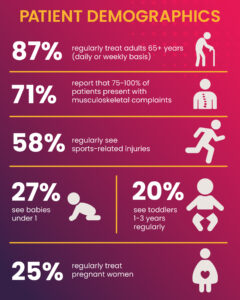
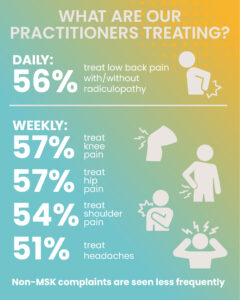
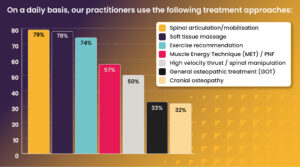
Our practitioners also reported having self-management discussions on a daily basis around general physical activity (65%), stress management (45%), medication advice (43%), occupational health or ergonomics (42%) and diet and nutrition (36%).
Our research showed that overall, practitioners feel positively towards evidence-based practice (EBP). This reflects a trend over the last few years towards agreement that EBP improves patient care. However, the main perceived barriers are lack of research skills and time constraints.
The project was fully funded by the Osteopathic Foundation; however, the funder had no role in study design, data collection, analysis or manuscript preparation.
NCOR provided support in the form of infrastructure and personnel, with Health Sciences University providing hosting and administrative support and UCO School of Osteopathy supporting through academic collaboration and expertise.

In terms of professional development, as the first osteopathic PBRN in the UK, the NCOR Research Network establishes a benchmark for future research. It builds research capacity among practicing osteopaths, promotes evidence-based practice throughout the profession and provides a framework for collaboration between clinicians and academics.
The network impacts healthcare policy by providing baseline data for policy development and professional standards, and evidence of alignment with clinical guidelines and national health initiatives. Importantly, it provides support for osteopathy’s role in both NHS and private healthcare systems, with valuable data for workforce planning and service development.
Impacts for clinical practice include practice standardisation through shared research participation, and quality improvement opportunities through data collection. Peer learning and professional interactions can be enhanced, and evidence used to inform the development and implementation of care.
In terms of research innovation, the new network provides infrastructure for future clinical studies and observational research, with methodology that can be replicated for other healthcare professions. Its data platform offers opportunities for longitudinal studies and comparative research, and there are international collaboration opportunities with existing PBRNs.
Within education, the NCOR Research Network offers student training opportunities in practice-based research, and enables curriculum development informed by real-world practice data. It will help both educators and practitioners develop their research skills, and facilitate knowledge translation between academic and clinical settings.
https://www.nature.com/articles/s41598-025-11527-4
https://www.journalofosteopathicmedicine.com/article/S1746-0689(24)00035-X/abstract
The project offers a wide range of opportunities to get involved for different groups.
For practising osteopaths:
For students:
For researchers:
For healthcare organisations:
Future research opportunities include:
Plans to further develop the network in the future include:
Ethics and Registration:
Transparency: all participants were provided with detailed study information by the research team and all participants provided informed consent.

Health Sciences University
Bournemouth Campus
Parkwood Road
Bournemouth
BH5 2DF
Health Sciences University
London Campus
275 Borough High Street,
London
SE1 1JE
Health Sciences University
Reading Campus
19 Castle Street
Reading
RG1 7SB