Building a healthier research culture
Catalysing research assessment reform in a small, specialist institution

Catalysing research assessment reform in a small, specialist institution

Health Sciences University is a small institution with a nascent but rapidly growing research reputation. Our mission is to create and sustain a healthy research culture, in which researchers are supported to fulfil their potential and the quality and impact of our research is maximised.
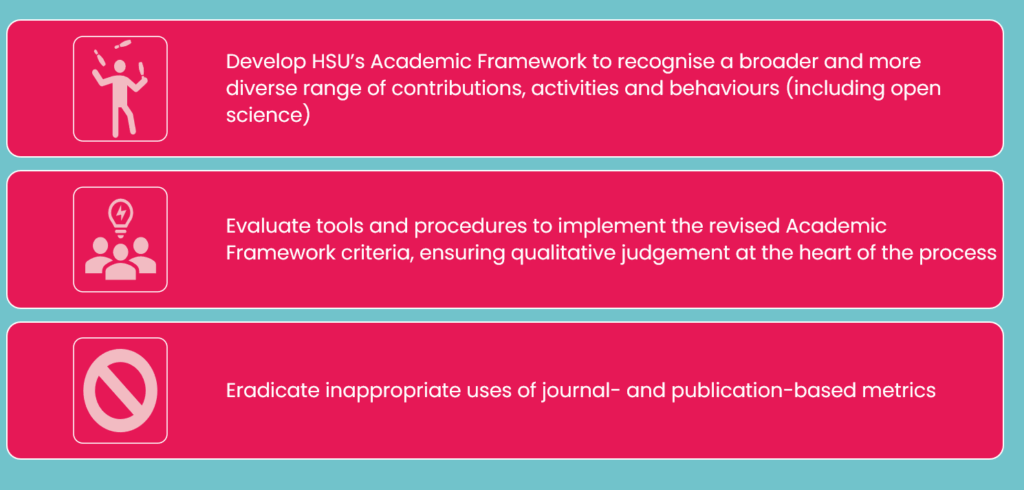
To achieve this, we needed to revise our academic framework so that it recognised a broader range of contributions, activities and behaviours, and placed qualitative judgement at the heart of our academic career assessment procedures.
Through this project, a coalition of internal stakeholders, including researchers at all career stages, have developed and strengthened the criteria, tools and procedures used in our academic framework. This was piloted through our annual performance review exercise in 2025 and we are now evaluating the approach and embedding the learning in other assessment activities.
Activities were undertaken throughout the project to accelerate the understanding and adoption of research assessment reform across the university. We anticipate our experience and learnings will be of particular interest to other small and specialist institutions and those in the health sciences domain.
The project’s mission was to raise awareness of the importance of research assessment reform across Health Sciences University (HSU). We aimed to ensure our staff were upskilled in the latest innovations in academic career assessment, actively engage a diverse group of staff in the process of reform, and accelerate our university’s pace of institutional change.
The objectives of the project were to:
The project’s principal investigator was Dr Julie Northam and the core team included Dr Alister du Rose, Cherry Brennan, Dr Hazreen Majid, Dr Jerry Draper-Rodi, Lisa Andrews, Dr Michelle Evans, Dr Michelle Holmes, Rebecca Old, Prof Steven Vogel and Susan Taylor.
We wanted to find out what our staff thought the university should value in research and researchers, so that we could ensure these values were reflected in our research assessment criteria. To do this, we set up a collaborative Padlet wall, which generated valuable input from a diverse range of staff and postgraduate research students. We undertook a thematic analysis of the responses on the Padlet wall and used the Vitae Research Culture Framework to split them into four areas:
We found that many of the values and behaviours identified were not currently represented in our academic framework. For example, research integrity, open science and collegiality were missing or underdeveloped.
Using these findings to guide our core team discussions, we next ran a SCOPE workshop to start to assess the existing tools, criteria and processes currently used within HSU to evaluate the performance of researchers. Findings from the workshop were grouped into challenges and potential solutions.
The main challenges included an over-reliance on traditional metrics (such as number of outputs and grant funding) and the perception of a disconnect between our academic framework and annual performance reviews.
Through the SCOPE workshop, we also identified some key opportunities. These included prioritising qualitative review, embedding values and behaviours into our academic framework, improving research literacy among assessors and broadening our recognition indicators.
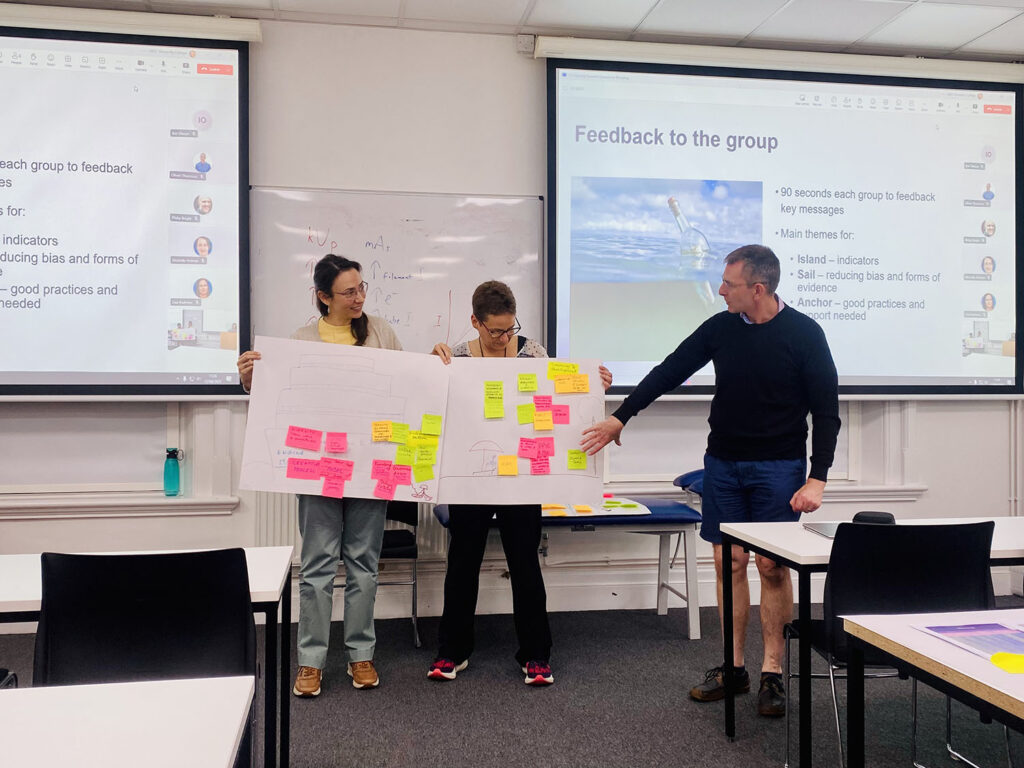
In June 2025, we held a dynamic, multi-format workshop to engage participants in reviewing current research indicators, proposing new and more inclusive alternatives, and exploring ways to better integrate qualitative and quantitative assessment. To ensure broad and diverse representation, workshop participants were selected through a random sampling approach and included researchers at all career stages, PGR students and contributors from the public and patients. We developed three engaging activities for the workshop, each led by a different member of the core team.
The key findings from the workshop were that participants wanted the academic framework to have broad categories of activities, with examples of outputs and clear indicators. They also wanted the academic framework to be career-agnostic, recognising that research capabilities and activities do not always map neatly to career stage, and for activities to be linked to values and behaviours.
The participants developed alternative qualitative and quantitative indicators and examples, and requested that the annual performance review process be based on a narrative CV approach. They wanted high-quality training to be provided to researchers and assessors, and, crucially, wanted stronger links between workload planning, appraisal, performance review, and HSU’s personal research planning process.
In July 2025, we ran an online exercise with workshop participants and members of the core team, using fictional vignettes to stress-test the proposed changes to the academic framework and annual review process.
Over the summer, we launched the revised academic framework criteria and performance review exercise. Training was provided to evaluators and research leaders, as well as researchers, for example, in writing and evaluating narrative CVs. The performance review exercise then took place.
We spent the final two months of the project evaluating the implementation of the new approach. Findings will be shared with staff and lessons learned will be shared with CoARA, other universities, GuildHE and at conferences.
The project was funded by the European Union as part of the CoARA Boost Cascade Funding programme. The project ran from 1 December 2024 to 30 November 2025.
At Health Sciences University, we’re pursuing an ambitious strategy to strengthen our research culture and performance. This project enabled us to accelerate our progress and allocate resources to delivering our research assessment reform strategy, making tangible progress that will lead to sustained change throughout the institution.
The project helped build institutional knowledge and awareness of academic career assessment, which is essential for ensuring that evaluators feel confident in conducting their performance review responsibilities. The SCOPE framework and the coalition approach that we took, including the direct involvement of researchers, increased the likelihood that learning was embedded across the university, for example, in appraisals and recruitment.
Recognition of a broader and more diverse range of academic contributions in the academic framework, coupled with specialist training for evaluators in equality and diversity in assessment, benefitted researchers by ensuring the performance review exercise was fairer and more inclusive.
As a small and specialist university, we provided a useful testbed for research assessment reform in similar institutions, which are often teaching-focused with nascent research cultures. The project will add value to the community by providing lessons learned from a different type of institution and will be of interest to small and specialist universities, those undergoing a merger, and/or those in health sciences disciplines. For example, GuildHE Research, an officially recognised representative body that champions research in small and specialist institutions, has committed to engaging their members with the learnings from our project. We are committed to sharing lessons learned with the UK National Chapter, CoARA Working Groups, and with professional associations such as ARMA/EARMA.
Our CoARA Action Plan, which includes the project’s actions, is available via Zenodo here: Health Sciences University CoARA Action Plan v1 (March 2025).
We’re always happy to hear from other people interested in research assessment reform! To discuss the project, or talk about good practice or ideas for fairer and more inclusive research cultures, please contact Dr Julie Northam by email: julie.northam@hsu.ac.uk.

Health Sciences University
Bournemouth Campus
Parkwood Road
Bournemouth
BH5 2DF
Health Sciences University
London Campus
275 Borough High Street,
London
SE1 1JE
Health Sciences University
Reading Campus
19 Castle Street
Reading
RG1 7SB