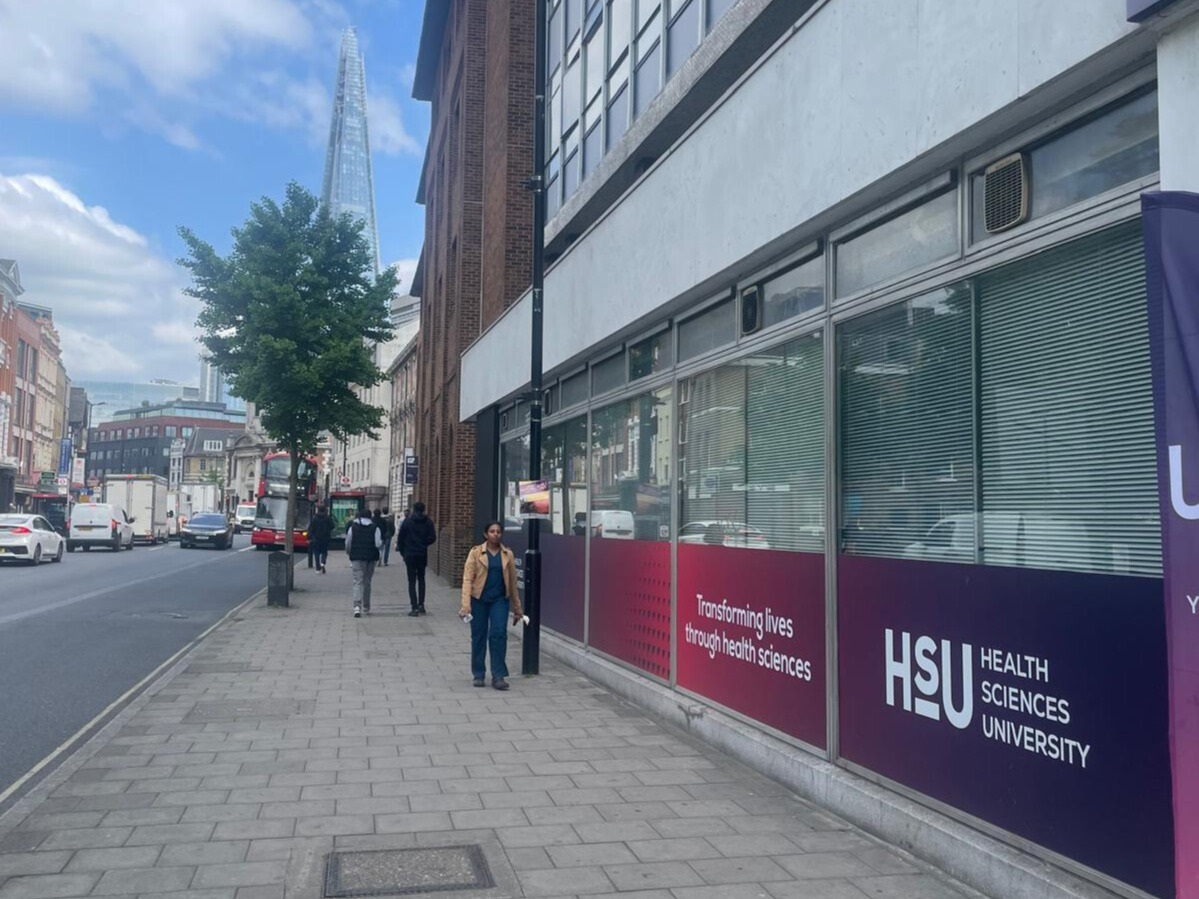
An innovation developed through HSU’s Centre for Osteopathic Research and Leadership (CORaL) has been selected by the World Health Organization as one of just 21 projects worldwide to feature at the WHO Global Summit.

Global Evidence-Based Neonatal Osteopathic Care Framework
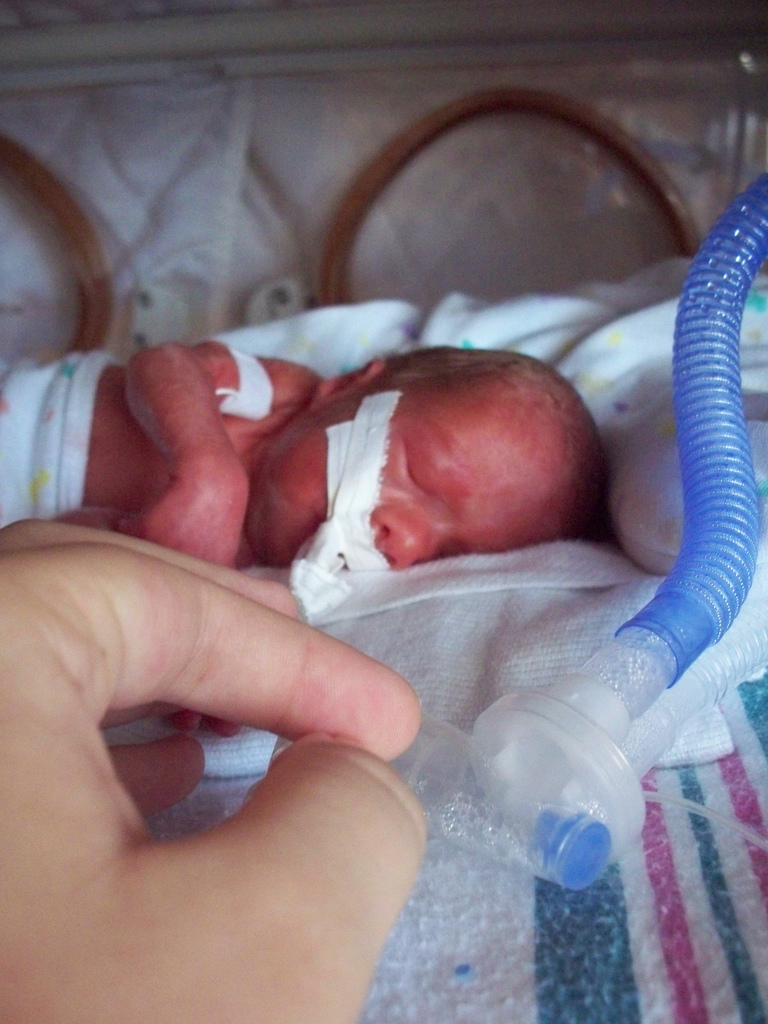
The Global Evidence-Based Neonatal Osteopathic Care Framework represents a pioneering approach to improving outcomes for the world’s most vulnerable patients: newborn infants requiring intensive care. Developed by the Centre for Osteopathic Research and Leadership (CORaL) at UCO School of Osteopathy, United Kingdom, this innovation is the first systematic integration of robust clinical evidence with practical global implementation protocols for osteopathic care in neonatal settings.
Neonatal mortality remains a critical global health challenge, with 2.4 million deaths annually. Healthcare systems worldwide are seeking cost-effective interventions that can reduce hospital stays whilst maintaining or improving safety outcomes for vulnerable populations. Our framework addresses this urgent need through evidence-based traditional medicine approaches that are both clinically effective and economically viable.
Our framework uniquely synthesises findings from multiple randomised controlled trials into a comprehensive, scalable approach suitable for diverse healthcare systems – from high-resource neonatal intensive care units to basic neonatal facilities in lower-resource settings.
Our framework is supported by rigorous scientific evidence demonstrating both effectiveness and safety:
Multicentre Randomised Controlled Trial (n=695 infants):
The framework demonstrates exceptional potential for worldwide implementation:
Economic Benefits
The framework promotes universal access through:
The Global Evidence-Based Neonatal Osteopathic Care Framework has been developed by an international collaborative team from the Centre for Osteopathic Research and Leadership (CORaL):
Lead Applicant:
Dr Ana Paula Ferreira
Core Team:
Dr Loïc Treffel

Prof Chantal Morin
Prof Amie Steel

Dr Jerry Draper-Rodi

Institutional Affiliation:
Centre for Osteopathic Research and Leadership (CORaL)
Health Sciences University, UCO School of Osteopathy
United Kingdom
The framework is supported by an extensive collaborative network spanning multiple continents:
We are actively seeking collaborations with:
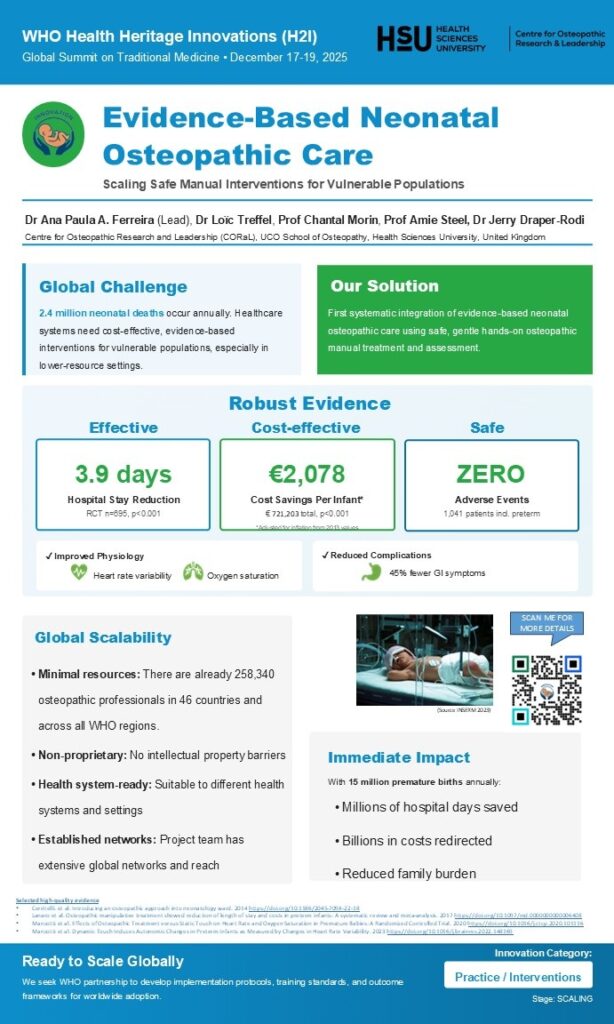
Conference Poster
Our large-format presentation poster provides a comprehensive visual overview of the framework, including clinical evidence, implementation pathways, and global impact potential.
Presentation Slides
Detailed slides from our WHO Traditional Medicine Global Summit presentation, offering an in-depth exploration of the innovation’s scientific basis and scaling strategy.
WHO Health Heritage Innovation V1 (1)
We are honoured to have been selected as finalists in the WHO Health & Heritage Innovations (H2I) Open Call, one of 21 innovations recognised globally for their potential to strengthen Traditional Medicine systems as living, dynamic contributors to health equity and sustainability.
Event: WHO Global Summit on Traditional Medicine
Date: 17-19 December 2025
Region: European Region
Category: Practice/Interventions
Stage: Scaling
The H2I Open Call seeks to identify and overcome scientific and technical barriers that limit the scale-up of Traditional Medicine for improved health equity and sustainability. Our selection recognises the framework’s robust evidence base, global scalability potential, and alignment with WHO’s Traditional Medicine Strategy principles.
Our framework directly addresses multiple WHO strategic objectives:
The Global Evidence-Based Neonatal Osteopathic Care Framework stands ready for international scaling. With robust clinical evidence, demonstrated cost-effectiveness, confirmed safety across diverse populations, and an existing global practitioner network, we are positioned to make a meaningful contribution to neonatal health outcomes worldwide.
We welcome dialogue with healthcare systems, policymakers, training institutions, and implementation partners interested in bringing this evidence-based traditional medicine innovation to their settings.
Cerritelli, F., Martelli, M., Renzetti, C., Pizzolorusso, G., Cozzolino, V., & Barlafante, G. (2014). Introducing an osteopathic approach into neonatology ward: the NE-O model. Chiropractic & Manual Therapies, 22, 18. https://doi.org/10.1186/2045-709X-22-18
Cerritelli, F., Pizzolorusso, G., Ciardelli, F., La Mola, E., Cozzolino, V., Renzetti, C., D’Incecco, C., Fusilli, P., Sabatino, G., & Barlafante, G. (2013). Effect of osteopathic manipulative treatment on length of stay in a population of preterm infants: a randomized controlled trial. BMC Pediatrics, 13, 65. https://doi.org/10.1186/1471-2431-13-65
Cerritelli, F., Pizzolorusso, G., Renzetti, C., Cozzolino, V., D’Orazio, M., Lupacchini, M., Marinelli, B., Accorsi, A., Lucci, C., Lancellotti, J., Ballabio, S., Castelli, C., Molteni, D., Besana, R., Tubaldi, L., Perri, F. P., Fusilli, P., D’Incecco, C., & Barlafante, G. (2015). A Multicenter, Randomized, Controlled Trial of Osteopathic Manipulative Treatment on Preterms. PLoS ONE, 10(5), e0127370. https://doi.org/10.1371/journal.pone.0127370
Lanaro, D., Ruffini, N., Manzotti, A., & Lista, G. (2017). Osteopathic manipulative treatment showed reduction of length of stay and costs in preterm infants: A systematic review and meta-analysis. Medicine, 96(12), e6408. https://doi.org/10.1097/MD.0000000000006408
Manzotti, A., Cerritelli, F., Chiera, M., Lombardi, E., La Rocca, S., Biasi, P., Galli, M., & Lista, G. (2020). Neonatal assessment manual score: Is there a role of a novel, structured touch-based evaluation in neonatal intensive care unit? Frontiers in Pediatrics, 8, 432. https://doi.org/10.3389/fped.2020.00432
Manzotti, A., Cerritelli, F., Chiera, M., Lombardi, E., La Rocca, S., Biasi, P., & Lista, G. (2022). Newborns’ clinical conditions are correlated with the neonatal assessment manual scorE (NAME). Frontiers in Pediatrics, 10, 967301. https://doi.org/10.3389/fped.2022.967301
Manzotti, A., Cerritelli, F., Lombardi, E., Tansini, L., Pisanu, D., Di Leo, D., Vergani, E., Righini, A., Arrigoni, F., Fanos, V., Rescigno, M., Veggiotti, P., Lista, G., & Gazzolo, D. (2025). Impact of touch interventions on brain activity in moderately preterm infants: study protocol for a pilot randomised controlled trial. BMJ Open, 15, e102964. https://doi.org/10.1136/bmjopen-2025-102964
O’Connor, S. (2025). Approche neuroprotectrice de l’ostéopathie chez les grands prématurés : tolérance, sécurité et bénéfices potentiels [Doctoral dissertation, Université de Sherbrooke]. Université de Sherbrooke.
Pizzolorusso, G., Turi, P., Barlafante, G., Cerritelli, F., Renzetti, C., Cozzolino, V., D’Orazio, M., Fusilli, P., Carinci, F., & D’Incecco, C. (2011). Effect of osteopathic manipulative treatment on gastrointestinal function and length of stay of preterm infants: An exploratory study. Chiropractic & Manual Therapies, 19, 15. https://doi.org/10.1186/2045-709X-19-15
Centre for Osteopathic Research and Leadership (CORaL)
Health Sciences University, UCO School of Osteopathy
United Kingdom
Lead Contact:
Dr Ana Paula Ferreira
Email: AnaPaula.Ferreira@hsu.ac.uk
This innovation is classified under WHO’s Traditional, Complementary and Integrative Medicine (TCIM) framework and represents a cross-sectoral partnership advancing evidence-based traditional medicine approaches in modern healthcare settings.
Stay up to date with our discoveries, events and impact stories from across the HSU research community.
An innovation developed through HSU’s Centre for Osteopathic Research and Leadership (CORaL) has been selected by the World Health Organization as one of just 21 projects worldwide to feature at the WHO Global Summit.
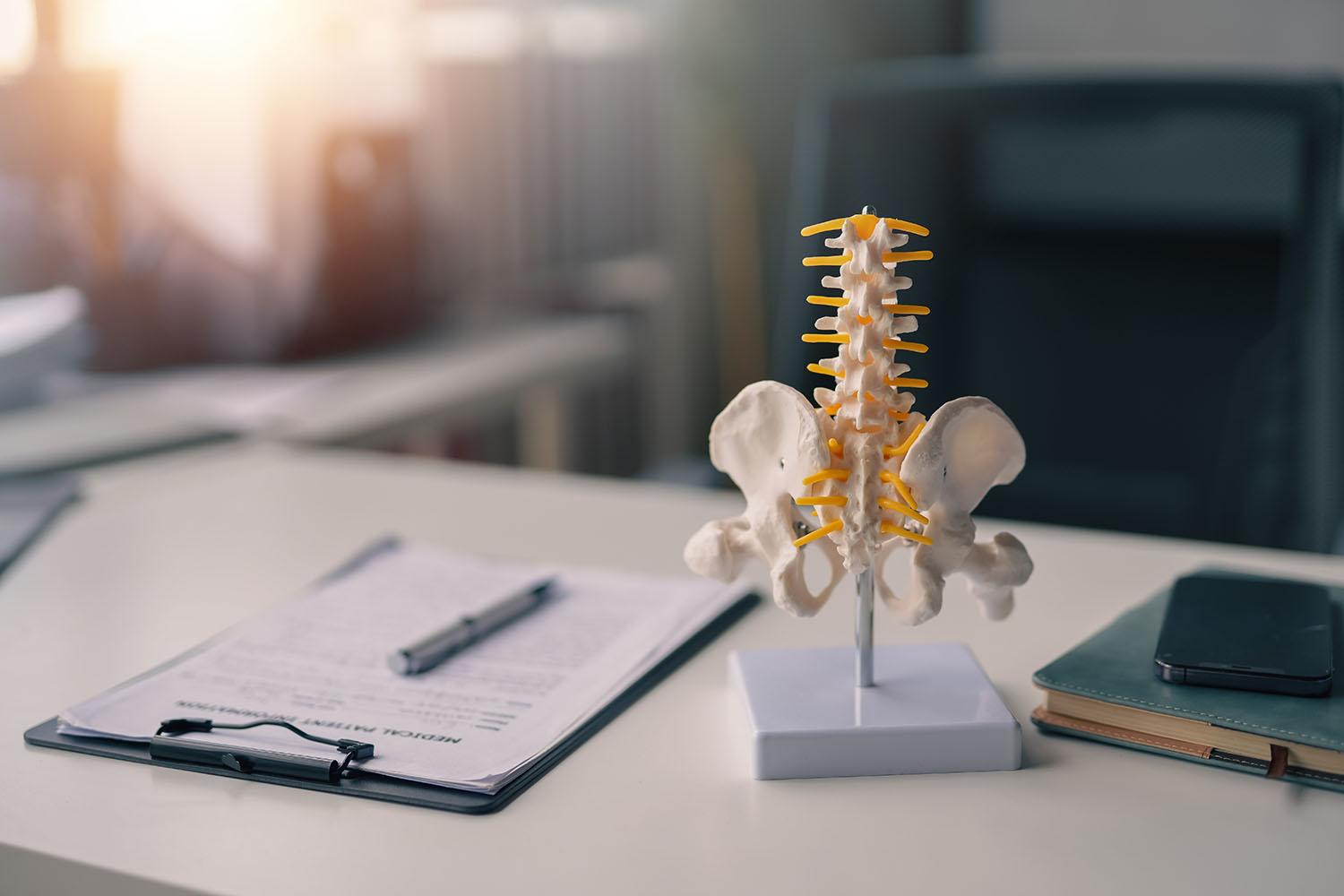
In October, HSU was pleased to celebrate the publication of the Priorities for Osteopathic Care (PROCare) study in BMJ Open.
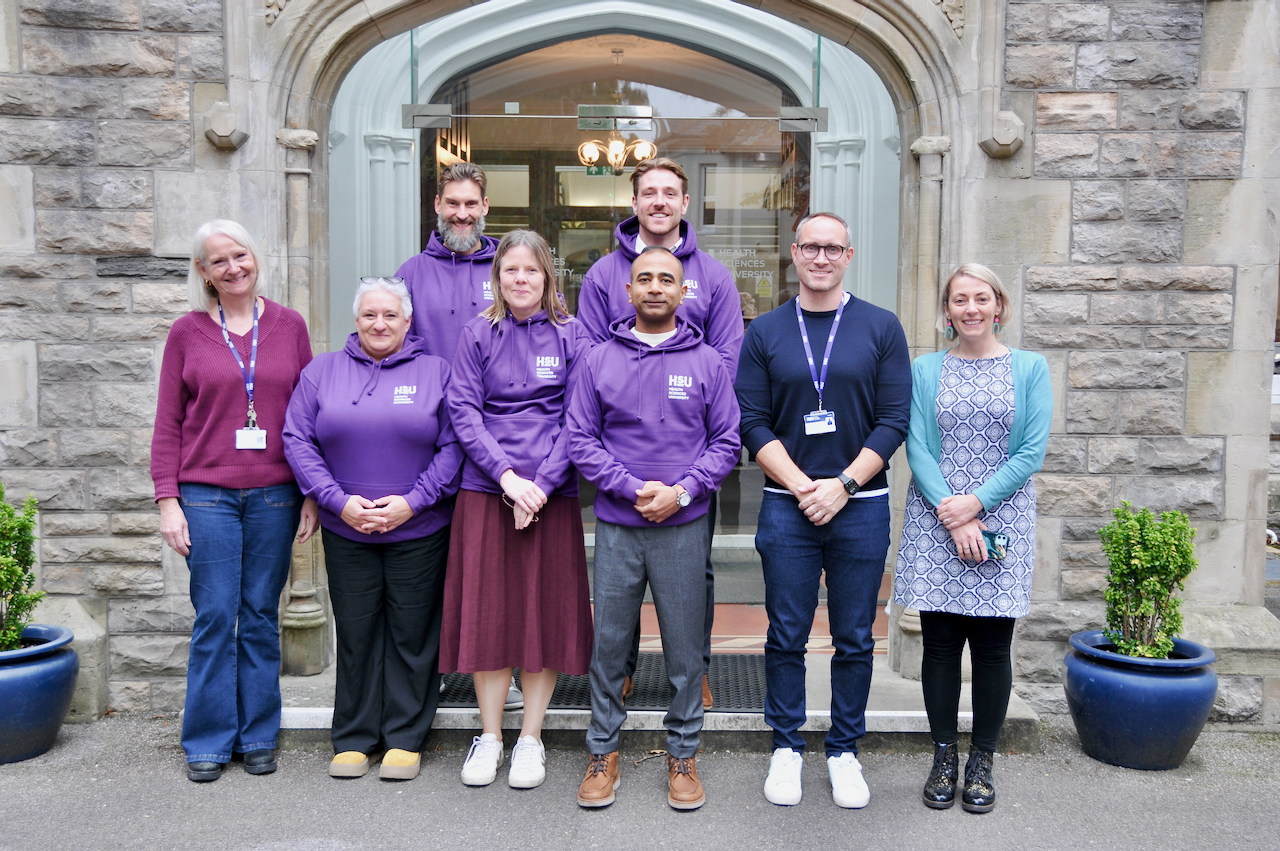
Earlier this week, we were pleased to welcome 13 new PhD students to Health Sciences University during our induction event.

We're proud to share exciting research from Professor Steven Vogel and Emeritus Professor Alan Breen at HSU, part of a unique longitudinal study examining how UK chiropractors, osteopaths and physiotherapists manage low back pain.
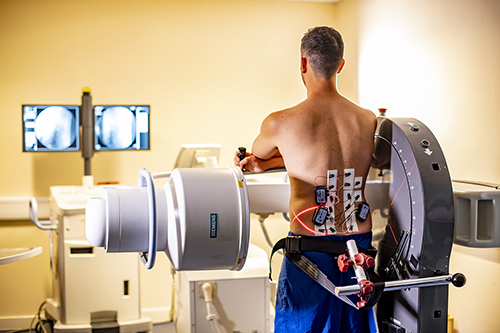
The Chiropractic Research Council (CRC) has gifted its funds to the new National Centre for Chiropractic Research (NCCR) based at Health Sciences University (HSU) and in partnership with London South Bank University, McTimoney College, Teesside University, and the University of South Wales.



Health Sciences University
Bournemouth Campus
Parkwood Road
Bournemouth
BH5 2DF
Health Sciences University
London Campus
275 Borough High Street,
London
SE1 1JE